Showing posts with label African tribes. Show all posts

Wednesday, 9 January 2019

Speaking Masai language (Maa) continued

I have introduced to you the very basics of Maa or the language of the Masai now nearly a year ago. Where does time fly?!?

Capturing beautiful moments with dancing Masai 

So I would like to continue this post and give you even more of an insight into this beautiful nilotic language.
Nilotic literally means 'coming from the Nile' and refers to the fact that this kind of language was first spoken in the Nile area, coming from Egypt, Sudan, Ethiopia and moving into Kenya and Tanzania.

I have written a similar post for Africa Geographic's blog and someone commented saying how unnecessary it was to know Maa or even Swahili (the National language of both Kenya and Tanzania) stating that it was sufficient to know English, French or Arabic. Well this person might think that it is OK to speak the language of the colonialists but I like to disagree.

Practising to dance like a Masai woman.

The language of a people is the gate to their hearts. It shows them that you make an effort to understand them and communicate with them. It makes it easier for them to trust you and to welcome you into their homes. For me, travel is meeting new people and getting to know different cultures and you can only really fully get to know a culture when you speak at least a few words of the native language.

So here are a few simple expressions and phrases that might come in handy when you are in Tanzania or Kenya on Safari or on Zanzibar encountering Masai and Samburu people.

Masai warrior jumping during a dance.


Kai ta?                                An informal greeting, loosely translated meaning 'what's up?'
Kiti                                      Answer to 'Kai ta?'

Keiya toi?                          Same as 'Kai ta'
Sidai                                   Answer to 'Keiya toi'; also means 'good', 'nice', 'beautiful'

Kai iji enkarrn inno?      What is your name?

Aji......                                  My name is......

Ai?                                        Where?

Anu?                                    When?

Kanyoo?                              Why?


Kai eti....?                             Where is.....?

Choo                                     Toilet (Swahili as there is no word for toilet in Maa)

Kai iloito?                            Where are you going?

Aloito.....                               I am going.....

Kanyoo iyesita?                  What are you doing?

Kai emanya?                       Where do you live?

Kai ingwaa?                         Where do you come from?

Aata esumaji                       I am hungry

Aiyo....                                   I want.....

Maiyo.....                               I don't want. ....

Aata......                                 I have......

Maata.                                   I don't have.

Anyorr                                  I like

Manyorr                               I don't like

Arra                                       I am

Marra                                   I am not

Enchake                               I would like/Please give me

Enkarre                                Water

Food                                      Endaa

Ugali                                     Emutu (staple diet in most sub-saharan african countries,                                                                   made of dried maize)

Meat                                      Ngiri


Personal pronouns

Nanu                                     I

Iye                                         You

Elle/enna                              He/She (there is no 'it' in Maa)

Iyook                                     We

Ndai                                       You

Kullo/Kunna                         They (Male/Female)


Awe-inspiring human beauty: the Masai.


Sooooo I will leave it at these for now as I think these phrases will occupy your brains quite a lot! 😊

Please let me know, if there is anything specific you would like to know.

Wishing you a great rest of the week, until my next post!


Monday, 3 September 2018

Swahili for beginners

Hi everyone!


I have had a few visitors lately, many of whom were struggling to get to grips with Swahili. 

So here is a beginner's guide to Swahili, the official language of Tanzania and Kenya.

The way you will be welcomed to these two beautiful countries will be quite different and definitely warmer if you know a few phrases in Swahili.


During the recent visit of my friend from Colombia (myself: left in pink)


Hello/How are you?                 Habari/ Habari yako?

Hello back/ I am well               Nzuri/safi

Are you OK?
(Literally: peaceful)                  Salama?

Answer to 'salama'                    Salama

Habari za asubuhi?                  Good morning

Habari za leo?                            Good day/afternoon

Habari za jioni?                          Good evening

Nzuri/safi/salama                       Replies to anything starting with 'habari'/ different
                                                       versions of 'good'

Shikamoo                                     Respectful greeting to elders (from arabic)

Marahaba                                    Reply to 'Shikamoo'

Haujambo?                                  Are you well?/How are you?

Sijambo                                         I am good, reply to 'haujambo'

Jambo!                                          Tourist version of 'haujambo'


Wapi?                      Where?

Nani?                       Who?

Nini?                        What?

Lini?                         When?

How many/
How much?            Ngapi?


What does this cost?                  Shillingi ngapi?/Bei gani?

What is your name?                   Unaitwa nani?

Where is.......                                 Iko wapi......

Toilet                                              choo

Restaurant                                    hotel/ sahemu ya chakula

Shop                                               duka

Beach                                             pwani

Water                                             maji

Food                                               chakula


Thank you!                  Asante.                                      1         moja                   6      sita

Excuse me                    Samahani                                 2        mbili                   7      saba

You are welcome        Karibu                                       3        tatu                      8     nane

                                                                                           4        nne                      9     tisa

Good bye                      kwa heri                                   5        tano                    10     kumi
See you later                baadaye                                  


I will leave it at these for today so as not to fry your brains! Let me know if you would like to know more or if there is anything specific you would like to get into.


Wishing you a great day!


Wednesday, 1 August 2018

Saving Masai culture

Today I am inspired to write to you by the negativity of some of our fellow human beings.
Not long ago someone confronted me claiming I was 'forcing my western ideals' onto the Masai. Well just as I am writing this, I am laughing to myself at how ridiculous this notion is. But it got me thinking anyway.

I did indeed change my outlook on Masai life and culture but not in anyway to the point where I want to forge them into someone resembling a person used to the standards of the First world. Not at all.

Myself in traditional dress during a ceremony.

For all those of you who know me personally, you know how much I have come to love the Masai, my husband's tribe who have become my tribe too. In the six years I have lived with them, it was and is me who adapted (and still adapts every day) to THEIR way of life, and not the other way round. 

And I would not have it any other way.

The Masai are the most generous, kindest, warm-hearted, even-tempered, most open and beautiful people I have ever met and I owe them so so much. I owe them like someone who has been taken in when they had nowhere else to go.

And they took me in. And I know now that that in itself is proof of my willingness and capacity to adapt to their way of life. It is proof of my respect for them, of the love and understanding I have in my heart for them and always will have.

But I have changed my attitude towards their culture. I have stopped being what I like to call a 'tribal purist'. Because I have come to understand that that is just ignoring the facts, ignoring the danger that threatens to swallow up their culture in the all too near future.

My husband's cousin herding our cattle.

From my earliest days on, I saw aspects of their culture that I knew in my gut, were not good. And when I say 'not good' I don't ONLY mean our standardised 'good' as in 'good versus evil'. I also mean not good FOR THEM. For their culture, for the survival of their ancient way of life.

Like sending your daughter off to be married when she has not even had her period yet. Like keeping her out of school precisely for that reason. Like teaching her that all she has to do in life is breed and raise children. Like buying ever more cattle when there is no longer enough grass or land for them to feed on. Like circumcising your son to be a warrior when he has not even reached puberty. Like switching from materials won from your animals to things you need to buy with money. Like disregarding your own culture's customs because now they are considered bothersome. Like inviting more and more people of different tribes into your land without knowing what this means for your culture and your children's future. Like selling off land. Like felling trees. Like wanting to have big farms to feed your ever growing families.

Masai girls.

To name but a few things. These are all things that I chose to ignore with the excuse that that is just what Masai culture is now. Because I thought that if I interfered, I would be forcing my views on them, tainting their culture.

But that could not be further from the truth. The truth is, is that if Masai culture is to survive the slow but steady approach of modernity into their lands and way of life, they have to start adapting.  They have to start changing the things that pose a threat to their survival from the inside out. Like those things mentioned above. Like continuing to having children uncontrolled. An exponential birth rate is a death certificate in times where an ever increasing human population is putting a strain on the last few remaining wild spaces and Masai rangelands.

There is no Masai who does not see it. Who does not see the way the land has changed. The way it seems to have shrunk away under the thunderous footfalls of thousands of humans who have encroached onto it. There is no Masai who does not complain about how his cattle are starving, how they are ill all the time, how he does not know where to graze them anymore for all the farms and settlements that have gotten in the way. They see it but they chose to ignore it out of ignorance and an incapacity to understand what is happening to them. They fail to understand that it is partly them who put a neck round their throat, slowly pulling tight. That part of their customs are outdated now and need to be stopped because they themselves are a risk to the culture that they used to be a part of. Like breeding breeding breeding.

Masai women at a ceremony.

The Masai used to be a warring tribe. Fighting for land,  water and cattle with their neighbouring tribes. There didn't used to be many warriors older than 30. Because they used to be warriors truly. Now they no longer are for various reasons, one of which is law enforcement. That is one part of their culture gone, which is sad but maybe it was not such a good part. And the fact that this part is gone, now has an effect on their numbers. The Masai are now one of the largest tribes in Tanzania and Kenya and their numbers continue to grow. Because of their inability to see what it does to them.

In between warriors.

To put it simply: More people from the inside (Masai breeding) and more people from the outside (neighbouring tribes breeding) causes free land or grazing land to become rarer and rarer. On top of this, Masai changed their diet from blood and milk to ugali made out of corn. So they started cultivating maize farms, as do their neighbouring tribes, which causes free land (woodland) to be deforested and turned into agriculture land, which again steals land from the Masai cattle. So their cattle grow hungry and produce less milk, which is part of the reason why the Masai changed their diet in the first place. So it is almost like a vicious circle: breeding=more need for food=establishing farms=less room for cattle=cattle starving=no milk=more need for food..... and so forth.

So where to break this vicious circle?

We tear it up right from the start with teaching the Masai that they NEED to have less children for their own sake. And by teaching them so, we do force our western views on them. We do. Because we love them and want them to survive.

Beautiful Masai rangelands that need to be protected.

So, is it true what I have been told? Yes, it is. And yes it did not used to be this way, but I am glad that it is now. I am glad that I have come to understand that the Masai culture is at risk of dying out.  That so much of it, is already dead. And that it is up to us, who have a view of the bigger picture and the ability to forsee their future, to tell them about it and to teach them ways to stop what is coming.

This is what I want to do. Because I love them. Because I want to preserve their beautiful way of life as much as I want my child to still encounter elephants in the African bush once he is grown. It is all part of our wonderful planet's inspiring diversity.

So I am no longer quiet when Masai parents keep their daughters out of school. I no longer shut up when women brag about how many children they have. I no longer encourage Masai to tend to their own farms but tell them to tend to their trees and land and cattle instead.
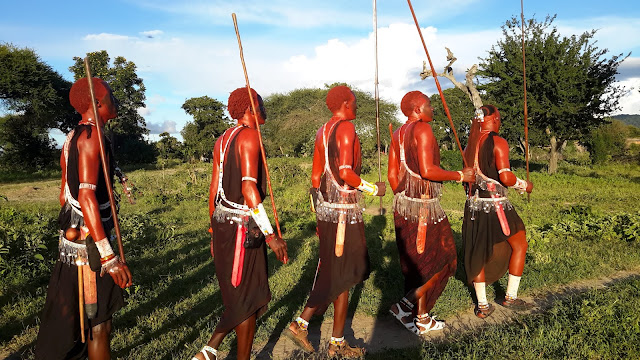
A culture worthy of our love and protection.

This is all part of the projects I have ran and am currently running. It is all out of love for the people of the Masai tribe and the beautiful land they live in.

With Stephanie's Masai Education Fund Vol. 2 I aim to encourage Masai girls to go to school. I want them to receive the education their tribe needs in order to survive.

Taking Masai children to school is not the end of their tribal culture. It does not have to be. It can be the way to save them. The beautiful Masai.

Check out my campaign to bring reusable sanitary kits to the girl students of our village by clicking HERE.

Thank you.

Sunday, 3 June 2018

Masai wisdom

Eight years in Africa.

Eight years in the land of elephants, lions and giraffe. In the land of open plains and acacia trees, in the land of the Masai people, Samburu, Himba, Zulu and Mursi tribes.

In the land where you never say no, even though yes often seems insane. In the land where no one is ever on time but everything somehow has its order.

In the land where the most stunning sunsets are everyday business and where the moon rises like a big red sun and the stars cover more space than the dark.

Masai warriors parading at a ceremony

What have these eight years done to me? They have turned me upside down and shaken out all the dust, the fear, the doubt, the hate. They have left me standing with wide open eyes, ready to see everything anew. To see everything from a selfless angle of love. And one of my greatest teachers are the beautiful people I am so lucky to share my life with: the Masai.

They have taught me that tears are only cried for the dead and that any other tears are cried in anger rather than sadness. They have taught me that children are tellers of the truth and that they lift you out from the darkest corners of your soul.

Overlooking the stunning Masai Steppe 

They have taught me that it is rude to not accept gifts, even when they come from someone who has nothing. They have taught me that being still does not mean you are moving backwards,  but that it gives you time to reflect on your next move.

They have taught me happiness can be found anywhere and any day and that it is you who creates it, for yourself and others.

They have taught me that accepting each other's differences teaches you to accept not only those different to you but also yourself.

They have taught me that inviting strangers into your house leaves you feeling connected to the world and is nothing but basic decency.

They have taught me that laughter and stories are more important than big cars and designer jeans.

They have taught me that dirty, skinny kids are happier than ours could ever be and that it is OK to play with sand and sticks.

My husband and I.

They have taught me that family is everything and that sharing makes you rich.

They have taught me to live slower and with more purpose.

They have taught me to be patient and that detours make the journey memorable.

They have taught be to observe more and judge less.

They have made me softer and harder at the same time.

Warrior herding his cattle

They have turned me into the person who talks to strangers when passing them on the street, who gives a random child a sweet just to see it smile. They have turned me into someone who fears the coldness of the western world and who has stopped trying to explain to those who have never been to Africa.


Do YOU understand?

Wednesday, 16 May 2018

More of a woman

There are days where I am just bursting with inspiration and often this inspiration comes from the beautiful people I share my life with, but sometimes (and this has been the case recently) I struggle to pick up a pen and start writing.


Today though I feel like I have something to share with you again and this comes from my recent wish and desire to improve the lives of my fellow Masai women and mothers.

With my son Yannik in May 2016

As I am a mother. And I am so proud and happy that I have chosen to become one.

I remember a friend of mine once telling me, that she asked herself, after the birth of her first baby, why she had not done this earlier as it is the easiest thing she has ever done. I have to say I disagree. For me, it is not the easiest thing, it is quite possibly the hardest thing I have ever done, but as is so often the case with us humans, the hardest things, that we cannot imagine ourselves doing or accomplishing in life, turn out to be the best, most rewarding things at the same time.

I for my part feel that I am complete now, but by that I do not mean I am completely happy or completely fulfilled. On the contrary, having a child, has left me with a hunger and a need to DO more, to ACT more, to BE more. It has opened my eyes and my soul and has made me want to reach out and connect with the world to bring good to it. It has made me stand up and work towards a better future for my child.


A family snapshot with all the women. (Myself: back row, right)

So I am not complete, but I am completely happy in myself. I have learned to love and accept myself for who I am. When you see your body go from small to big and back and when you have had your life turned upside down and go back to normal within a couple of years, you understand really that there is nothing wether good or bad that lasts forever and that there is nothing to worry about or fear as there is nothing really that you cannot achieve if you put your mind to it.

I am more of a woman now and more of a person and I am so thankful that I have made it through the first two years of my child's life and have come out stronger.

A beautiful Masai women and her son.

If you are thinking of having a baby, if it is your heart's wish, then do it, because you will be just fine. And if you already have become a mother, then please share with me here, what you feel your baby has given you in life. Mine has given me confidence and purpose and the strongest desire to live life to the full as well as huge amounts of compassion towards my fellow women, wether mother or not.

Wishing all you beautiful ladies (and gentlemen) a beautiful day!

Sunday, 29 April 2018

Blood drinking warriors or freshly picked spinach - Masai diet

Masai diet traditionally used to consist of just milk, butter, forest fruits and roots and the occasional bit of meat and blood.

These days however, because of a changing environment and the effects it has on their cattle, milk has become as precious as gold to the Masai, and just as rare.

An increasing human population has encroached onto their wild spaces and has lead to a decrease in cattle rangelands. Nursing cows produce much less milk now, which barely suffices to feed their calves, let alone the Masai who depend on it.

A boiling pot of ugali simmering on an open fire in a Masai hut.

Due to this, the Masai have had to change their diet, away from lactose products, given to them by their cattle for free, towards corn and vegetables which have to be bought. This has also lead to large areas of rangelands being deforested for the sake of farmland, which has increased pressure on their pastoralist way of life.

Warriors these days spend most of the year away from home, working in cities and tourist places to earn money to be able to feed their families.

My sister-in-law taking a break from cooking ugali to nurse her son.

A traditional Masai meal today consists of ugali, a thick paste made out of corn flour boiled in water, eaten with milk or vegetables. Common vegetables here are potatoes, carrots, peppers, cabbage, tomatoes, spinach and beans. They are usually fried in oil and then cooked in a splash of milk. No spices are used, only salt.
Rice is available to be bought, but as its price is high, it is only eaten on special occasions, like ceremonies.
Even meat these days, has almost become a luxury item as goats or cows are only slaughtered when there is a need to feed many people, as for festivities.

Freshly picked pumpkin leaves to be cut up and cooked.

When a goat or cow is slaughtered it is butchered in a very efficient, almost professional way and is split between men and women.
Cows, goats and sheep each have designated parts that are given to warriors, old men and women and children.
The stomach of a goat is for the men to use in the traditional meat broth which has medicinal properties and is drunk by everyone who wishes to do so. The stomach of a sheep however is designated to the women, as is its hindquarters, whereas the lungs and the chest are for the uncircumcised boys. The girls get the back of a goat or sheep.
Blood is drunk straight from the carcass while it is being butchered. On other occasions, the vein of a goat or cow is tapped into with a bow and arrow or a needle and the blood is caught in a cup and mixed with goat or sheep oil or honey as a traditional remedy for injury or illess.

A warrior drinking blood from a freshly slaughtered goat.

The corn needed to cook ugali, has to be bought or planted and is therefore costly, as are vegetables and often both are not available in sufficient amounts to feed large Masai families. The Masai therefore often only eat ugali once a day and as a second meal, cook a simple porridge out of the corn flour mixed with milk and/or water.
Malnutrition is an issue prevalent in Masai country, but one that is yet to be addressed by a worldwide audience.

It is one of the many challenges I hope to address by continuously working with our community members through my Masai Education Fund. Teaching women and men to use family planning methods to reduce the number of children they put into the world so that they are able to take better care of them and reduce the pressure an increasing human population is putting on their rangelands, cattle and therefore on the survival of their beautiful culture.


I have received nothing but love and support by my friends and family and likewise by people who I have never met but who have taken an interest in my efforts to increase quality of life in Masai country - and I would like to say THANK YOU!

If you too, would like to know how you can help, please get in touch, so that we may work together towards a brighter future for one of Africa’s last remaining ancient tribes.