Showing posts with label Kiteto. Show all posts

Tuesday, 4 February 2020

Flooded rivers, elephants and the spirit of Tanzania

On 4th January this year I celebrated 10 years of living in Tanzania.

I wanted to do something to remember - and simply going someplace new by myself, did not seem to make it justice. So I remembered my mother-in-law's long-standing wish to travel and to go on safari and I felt that it would be the perfect occasion to make this wish come true.

I decided to take them on safari in Tarangire National Park as I myself had never been there also and I decided to take two of my three mother-in-laws, Yayai and Totoi, who were the once who had expressed this wish together, my husband, his cousin, our son Yannik and Claudia, a girl close to my heart, my son's cousin and a girl I have known for the entire 8 years of her life.

Totoi, Yayai, Claudia, Yannik and I at the gate to Tarangire. 

I was nervous about taking so many of my family and so many who had never travelled before. I thought Claudia and Yannik would cry at the sight of swahili people and would be scared of the big busses we would travel in, and I thought my two mother-in-laws would suffer from motion sickness. Both of these fears turned out to have been superfluous.

We did the trip to Arusha to access Tarangire National Park in stages, as it is a long trip and all on dirt roads which had suffered extensivly from the ongoing rains.

We set off in the afternoon of the 25th January on three motorbikes to Kijungu where we planned to get a car to Kibaya, our district capital. From there we were to take a bus at 6 am the next morning, straight through the Maasai Steppe and straight to Arusha, a route I had chosen because it was shorter and in better condition than the usual route I would take to Moshi/Arusha via Handeni and Korogwe and also because I had never been that way before and had always wanted to see more of the Maasai Steppe.

Yayai, Totoi, Claudia and Yannik at our home, the day of our departure

We waited for two hours in Kijungu until finally a Toyota Noah turned up, fully loaded with used clothes he was transporting to Kibaya.
Four of us plus Claudia and Yannik squeezed into the back seat and Kiringo, Sokoine's cousin was in the front with 3 other people including the driver, who shared his seat with another person. Luckily the car was an automatic - I don't know how he would have managed to reach the pedals to change gear otherwise. I handed sick bags to my mother-in-laws and off we went.
The road was muddy but passable as it had not yet rained that day. It is 90 km to Kibaya from Kijungu and it took us 3.5 hours. It started raining half-way in and we made slow progress on the slippery road.
Then, just as we were about to enter Kibaya, we got to a stop at a bridge, where a trail of waiting cars made us stop ours too. The driver had alreday mentioned that he was expecting this - the bridge was flooded. What was usually a brook, had turned into a raging river and several cars on either side of it had stopped - too scared to try and drive through the thigh-high, fast-flowing water.


Enjoying the wildlife in Tarangire National Park. 

We had not eaten anything since breakfast, were tired and on edge and I was concerned about the children getting upset. We all got out to check out the water and witnessed a motorbike rider who nearly got washed away....other people were crossing by foot higher up the river and people were talking about having to sleep where we are to wait for the water to receed. I was rolling my eyes, thinking what  a great start to our trip this was....

Then luckily things got moving - a lorry braved the ride through the water and made it to the other side, accompanied by cheers from the people watching. Then another car, then a motorbike. Our driver called us, telling us to get in the car - he had seen enough to be convinced we would not be washed away. I was pretty certain also but just to make sure I told him to roll down the front windows, so that just in case we would have an escape route and I could pull them out one by one, being the only one in the car who knows how to swim......

We rolled down the hill, revved the engine and sped through the water.....we made it to the other side. We were so relieved. Yayai and Totoi had been so scared, they had their heads between their knees during the crossing - probably praying.
Yannik had been nervous too as he had experienced a few crossings like this in our village lately when he was riding with his father on the motorbike - he knows what water does to muddy roads and how difficult it is to navigate.

We made it to Kibaya, a short 90 km trip that should have taken 1.5 hours and during which I had no expected any difficulties - a bit shaken, but alive.

We took the bus at 6 am the next day. 380 km on dirt road through the Maasai Steppe to Arusha. It had rained at night and the roads were even muddier than before.  We had just left the bus stand in Kibaya and had turned a few corner when we got to a halt, the driver revving the engines of the old bus. One look through the window and it become clear that he is trying to find the right angle to take a very sharp corner on very muddy roads with a very large bus. He reverses a couple of times, makes an attempt, reverses again and then he swerves left to get a better angle and the tires give way on the muddy road and he drives us into the left-hand ditch of the road.
The bus is stuck at a precarious angle and it is clear that we will fall if he attempts to drive us put of the ditch. Everyone in the bus gets up at the same time, panicking, wanting to get out before he attempts anything.
I tell Sokoine to hurry and get Yannik out of the bus - adrenaline is already rushing through me - I have experienced these situations so many times and they always bring back the accident I had the first time I every visited Sokoine. We are in the back of the bus and it takes a loooooong time for everyone to get out. My Mamas are terrified and so am I but I try not to show.
Finally we make it out and we just start walking. We all just want to leave the muddy stretch behind and get on a good part of the road to continue our journey from, should the driver manage to get the bus out. We turn around to see what is happening after hearing the engine scream and with one big rush, the bus is out.
It takes a different route, meets us on the way and we all get back in.....reluctantly.  Yannik and the Mamas are nervous, Claudia is fine. Laughing even. I silently ask myself if this is an omen of what's to come or if the universe is just testing my spirits again.
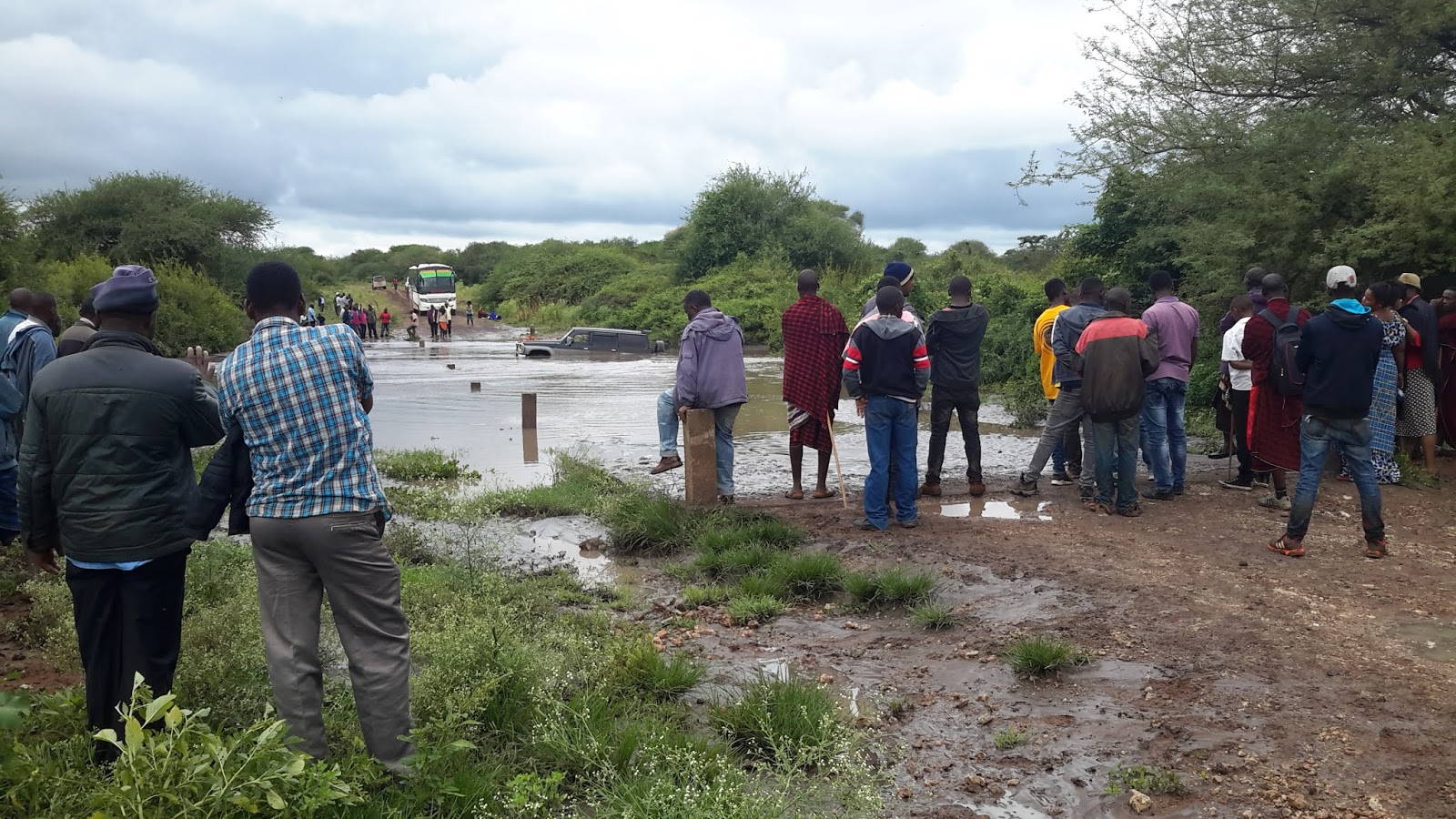
The flooded bridge at Terat, Simanjiro, Maasai Steppe on the way to Arusha. 

We drive for 5 hours without accident, through the Maasai Steppe, we see very few people, and if we see them they are Maasai herding their cattle. It is a beautiful route,  a beautiful part of the country I have come to love so much. We even see zebra and wildebeest on the way, grazing,  sharing their space with warriors herding their goats. It is a beautiful sight. Claudia shouts out every time she sees a zebra and the Mamas love it too.
At 12 pm,  in the midst of the Maasai Steppe, far away from 'civilization' the bus comes to a halt. Another trail of waiting cars in front, more whispers about a flooded bridge. I say 'oh no' quietly in my head.
We all get out to have a look and find, yes, a flooded bridge, a raging river and a landruiser stranded in the middle of it with the owner sitting on the roof of his flooded car.
He had tried to cross and failed. The water was reaching to its bonnet.
About 50 people on each side of the river and 5 vehicles on each side...all watching,  waiting.  The water is not too deep, people wade through it to try and attach a rope to the cruiser to pull it out but the rope is too short.
Whispers of ' we will wait till the water receeds', 'there is no crossing the water until we pulled the car out - it is blocking the way' and I realize that that is true. The landruiser had been turned by the water so that it lies across the bridge - the water would be passable with a big bus but the cruiser is blocking the way.

Yannik and Claudia posing by our bus as we wait to cross a flooded bridge on the way to Arusha. 

We wait and wait and wait. Apparently there is a tractor on its way to pull the car out. We go for a walk with the children, trying to find the zebras again. Sokoine says to not go too far as there are bound to be leopards around and I agree - so much prey around, the predator cannot be far. The Mamas are sleeping in the car, Yannik and Claudia are in good spirits despite not having eaten much apart from peanuts since last night. They laugh and play along the road and we take pictures by the standing bus. It definitely is an adventure - but I fear my Mamas already had enough of it.

Finally as we are all trying to sleep in the bus and I have to hide the last few drops of water we have from Yannik who says he is thirsty (as I don't know how much longer we will be stranded here), we here the revved of a tractor engine and look out the window to see the cruiser being pulled out. I can't help but to cheer and clap. 'Yes, we will make it out of here'.
Busses start pulling through the water and pass us. The rest of the passengers file back into our bus and the driver gets ready to pass. And we make it through without a problem. It is now 3 pm. We would have been in Arusha already.

We are thirsty and tired but glad that w ewont have to spend the night in the bush.  On we go and we break down for half an hour a little further down the road....but luckily some Maasai women sell soda on the side of the road so at least we get to quench our thirst. My head hurts,  I am hungry, tired and nervous. I pass paracetamol around to my Mamas who accept gratefully. Their heads hurt too.

We continue and finally at 6 am, after a 12 hour journey we make it to Arusha.
So so grateful and happy to have made it despite all the difficulties. The Mamas just fall into bed,  exhausted. Yannik is hungry and I run out to get him a chips and eggs omelette which he laughs. He is happy as can be,  excited to be in the big city.

We all go out later to eat and everyone is just happy and grateful to have made it.

Yannik enjoying Tarangire. 

The next day we have a rest day and arrange our safari to Tarangire.

We leave at 6 am the next day. It has rained so much that parts of the park are inaccessible, even in four wheel drives. The grass is green and high and animals are difficult to spot. Yet we see elephant, waterbuck,  giraffe, zebra, wildebeest, impala, warthog, baboons, vervet monkey and even two big male lions.
We try to drive through a very muddy bit and get another shock as the car slides from side to side and the makes a 360 as the driver tries to take a corner to get us out. I am nervous and tell the driver to slow down, Yannik feels my fear and starts crying and I take him in my arms and tell him not to worry as the car slides and swerves through the mud.
We make it out and continue. We take a rest at a beautiful picnic site overlooking the Tarangire river with vervet monkeys guarding over us trying to get crumbs of whatever we are eating. Yannik gets another shock as one of the monkeys he and Claudia approached gets aggressive, expecting them to feed him.
I think because Yannik is so small the monkey dared to challenge him - I run over and take a crying Yannik in my arms wondering if his love for monkeys is destroyed now. Claudia is laughing as always. The girl I had been so worried about turns out to be inquisitive and fearless in all situations. I am proud of her.

We continue our safari till about two pm and then head back to Arusha. Yayai says elephants are ugly and I say 'Whaaaat, they are beautiful!!!' She says, well you say that because you never had them trying to break your house and chase away your children and your cattle. And I see her point. It brings back childhood memories for her.
We get to Arusha at 5 pm and then get into a bus to Moshi. We are very tired from all the excitement and the challenging roads but I want to take them to Materuni waterfalls tomorrow, in the foothills of Kilimanjaro, close to Moshi town, so we need to get there tonight.

The mystical beauty of the Materuni waterfalls in the foothills of Kilimanjaro. 

 We make it to Moshi at 7.30 pm.
We are all exhausted. Yannik had fallen asleep in the last half hour on the bus and I carry him from the bus, to the taxi and into our hotel room and am thankful that he stays asleep through all of this. No dinner for him, but at least lots of sleep.
He had been so excited and therefore overtired the last few days, that he only got 8 hours sleep or so each night, so I am glad he fell asleep at his usual time today.

We leave Yannik with his grandmothers and Claudia, who say they are too exhausted to eat, and go out for beers, Sokoine, Kiringo and I. I have a pizza and a beer and am very thankful to be here in Moshi and to have made the safari happen. And I am exhausted.
The next day we get up, have breakfast and discuss we there or not to go the waterfalls. I really really want to take the Mamas and the kids but I know that the roads in the foothills of the mountain will be wet and slippery. It is a 40 minute drive to the gate and then a 45 minute walk through the hills to the waterfalls and I am worried that the Mamas might not be up for it. Weather forecast says rain I  the afternoon. The Mamas say they are ready to go and Sokoine and Kiringo say the same. So at 9.30 we set off into town and find a taxi for a good price that sprees to take us to the gate.
The driver is a young guy, very nice but doesn't quite know the way. He asks me for it and I tell him: 'What, you asking the Mzungu for the way - who is the taxi driver here? Ask people of the way'. And he does and we make it.
He then decides to join us on the walk as he has never been and he agrees to take us back in his taxi also.

Yayai and Totoi making their way towards the waterfalls. 

The paths up the mountain are slippery and steep and the Mamas are very nervous. They won't even look at the views of the mountain as they are too scared to fall. I feel for them and ask myself if I asked too much of them. We walk slowly in single line as one wrong step and you would slip on the wet mountain paths. Sokoine is ahead with the guide and the driver, guiding Yannik, Kiringo is looking after Claudia and I am in the back with the two Mamas telling them to take their time and guiding them over wooden bridges and slippery bits.
I start cracking up at the Mamas because I am so nervous that they might fall and break a leg and I apologise to them for putting them through this. They are in good spirits, and put on brave faces say, 'No Stephania, we are very grateful for you to bring us here, don't worry, we are fine. This is something that we will talk to about to our great-grandchildren - the day our white daughter brought us to Kilimanjaro'.
And I laugh and nearly tear up, grateful for their graciousness, their strength, courage and resilience. They show me again, why I love them so much.

We make it to the waterfalls, the Mamas are amazed and scared at the same time and I point them to a log to sit down and rest. They don't dare to go up close to the rushing water. I finally catch up with Yannik and Sokoine, Yannik seems teary and I figure he must be hungry, he just walked 45 minute up and down hills on slippery paths. I am so proud of him and call him my mini warrior. His grandmothers do the same and call him from their log. I give him a juice and biscuits and he cheers up.

We take a few pictures and take a rest in a nearby hut. The Mamas have taken their shoes off and look exhausted. I give out biscuits to everyone and tell them how well they did. Sokoine and Kiringo are pouring sweat and I laugh at them.
We start the way back slowly, the Mamas without shoes. The going is easier now as we are used to it and glad to be on the way back. I praise the sun which has come out to dry our paths. I laugh and giggle in the back with Kiringo, maybe it is adrenaline, maybe thankfulness that everyone is still healthy.

We make it to the car and drive back to Moshi. I take the drivers number and promise to bring him customers when I can.

Our team at Materuni waterfalls. 

My work is done - I took my family on safari and to the the water coming down from the famous Kilimanjaro and I finally feel like I can relax.
I have some work to do in town and let my family rest.
The next day is another errand day for me and a rest day for the family.
I have a go at taking Yannik into the pool at the Ymca, but he is scared of the water and gets out quickly.
At 3pm we make it to the bus stand to get back to Arusha after nearly losing Sokoine's backpack after we had left it in the back of a tukuk. We get it back and take the bus, so that tomorrow we would get the 6 am bus back to Kibaya. Our adventure is coming to an end and I am sad.
 No surprise, our bus breaks down about 30 km outside of Arusha. Lots of smoke coming out the engine and I tell Sokoine 'let's go find another bus.'

We get into a dala dala,  a mini van. Sokoine,  Yannik and I are next to the driver who takes a liking to Yannik, trying to speak Swahili with him all the way. Yannik knows mainly Maa, his tribal language and little English and Swahili but the two manage to communicate and it is lovely to see.

It is the warmth and kindness of the Tanzanian people that has won my heart. Hardly would you get into a bus in Europe and have the driver engage you and your kid in conversation.
We make it to Arusha around 6 pm and I get bus tickets for the next day. The Mamas again are too tired too eat.
The next day, our journey passes uneventfully. The rains had not been that heavy the last few days and all the bridges are passable again. We again see Zebras and wildebeest grazing alongside Maasai cattle and that makes me so happy. I think 'This is how it is meant to be - man and animals in harmony. The Maasai still know what that means, while we in the western world have forgotten it'.
We make it to Kibaya at 3 pm.
I am sad to be back and at the same time relieved to have made it safely despite the difficult travel conditions.

The next day we take it easy, I am exhausted due to lack of sleep and worry about getting my family home safe on these dirty roads. It rained at night and we still have 100 km of mud between us and home.
We get in a minibus at 1 pm and thankfully the roads are pretty dry despite a drizzle.
Only 20 km outside Kibaya though we get to another flooded bridge - and another car stuck in the water, blocking the way.
There is a tractor on the other side and rumours say, it will pull the car out. Yannik is tired and nd nervous about the water - he has seen it too many times now. He tells me: 'Mama, let's just go by foot, I don't want to get back in the car, I don't like the water'. My sentiments exactly. I see the way the car is stuck, its backwheel in a ditch in the mud and I ask myself  how our old minibus is going to make it through it.
Sokoine says we should get back in the bus, as soon as they pull the car out and I refuse, saying I am going to strap Yannik on my back and walk through the water. People had been passing and it was only knee-high, flowing slowly. I was much more confident wading through it that sitting in our bus.


The car is pulled out and I say to Yayai, give me your cloth - I want to put Yannik on my back and walk. And she says: 'Right, here you go, let's go together'. I put Yannik on my back and take her hand and we start wading through the water. Totoi takes the hand of an elderly Maasai man and off we go. I look back and see Kiringo and Claudia standing at the water's edge, giving us instructions of where to go and I tell him: 'Let's go, take Claudia'. He does and follows us. Sokoine arrives out of nowhere, wanting to help us, but he sees that we got it all under control and goes back to help push our truck. We make it to the other side safely and I cannot help but ask myself how many more obstacles fate will put in our way until we make it home safely.
We all look back to see our truck shaking and rolling its way over the broken bridge and through the mud.
We get back on, reluctantly and continue our trip.
We see rain falling close to home and just pray that we will get there.
We make it closer to Kijungu, Yannik playing horn which is missing in our bus, when we have to pass herds of cattle, much to the amusement of our driver: 'Beep beeeeeep' he goes.
 We share grilled corn that we bought on the side of the road, the bus passengers having become family after we made it through the hellish water. An older man, passes half a corn to Claudia and she hesitates to accept and I tell her to take it and say 'asante' which she does and I can't help but smile at this token of love and humanity being shared between strangers. Then I see our driver break his cob in half and pass it to one of his passengers and I am reminded again why I love this country so much.

Nothing is taken for granted - dangers and difficulties are expected at each moment and they are being taken in their stride, with courage and dignity and afterwards people are not scared or angry, but happy and thankful to be alive. And they go and share corn with each other that they bought with the little money they have. But here in Tanzania, what you have, you share and you don't think twice about it. To eat while your neighbour is not eating, is something that simply feels wrong and that is easily corrected by sharing.
I am sitting in this old cluttery minibus, exhausted, in my soaking wet sandals from passing through a river, looking at dark thunder clouds threatening our safe return back home and I get teary thinking how thankful I am for it all. How alive I feel and how full of love. And I know that we will make it. And if we have to walk the last kilometres - I am ready, I say.

We make it to the turn off to our village after it had started raining again and after the bus had nearly slid into a ditch again, to which Yannik told the driver 'Pole pole', which means slowly in Swahili, much to the amusement of the entire bus - and Sokoine's brother Lemomo is waiting there with our motorbike to take us back home.

We are all tired of the combination of mud and cars, so we tell him to just take our bags and let us walk. Three kilometers by foot to get home seems like nothing to the distance and the challenges we had already behind us.
So we walk, my family and I and stop by Sokoine's sister's home on the way to distribute biscuits. We walk through dirt and mud and water and laugh and say words of thanks to have made it home safe.
And this is where our adventure ends.

And I say to Totoi and Yayai: 'If it weren't for the mud - I would turn around right now and do it all again.'

Thursday, 13 December 2018

Quack Quack or how Masai women give birth

One of the things I love about Africa is that it let's you experience so many new things that you never dreamed of seeing.

One of those things I experienced with the Masai, is witnessing childbirth.

The wive of my husband's brother who gave birth recently. 

As generous, warm and welcoming the Masai are, I was first invited to watch a Masai lady give birth in February 2012, when I had only been living with them for a month.

Masai women traditionally have their babies at home, aided by a traditional midwife and many many of their female relatives.

The hut in which a woman is labouring is swarmed with her sisters, neighbours, mother and even grandmother. Any woman who is around is invited to watch and to support her.
However, there are rules regarding age and respect for your elders. No woman younger than the lady in labour is allowed to watch. Also, pregnant ladies are not allowed into the hut until the child is born and mothers with babies who have not yet teeth are not allowed unless they leave their children to be watched by someone outside of the hut.

Myself with two of my sisters-in-law during a ceremony.

The traditional midwive and older ladies sit on the bed with the woman in labour, holding her, rubbing her back and checking her dilation every so often. They are all naked from the waist down. This, they believe, helps the woman relax and open herself for childbirth.

After the baby is born, the traditional midwive also oversees the passing of the placenta. To help this along, a boy (or the husband of the new mother) is called to climb the roof of the house with a stick and tap it repeatedly saying 'Quack' over and over again until the placenta is out.

It is then wrapped in leaves and taken outside by two women holding a machete. The machete is used to fend of wild animals as well as men while they complete their task of burrying the placenta in the bush.


Masai women dancing at a ceremony after the birth of a child.
The women that have been called to witness the birth, help by cooking tea or porridge and boiling water for the new mother and the baby as well as the helpers. They also help clean up after the birth. Then no matter what time it is another pot of tea is cooked for the helpers.

The day after the birth a sheep is slaughtered and people are invited to celebrate. The new mother is given as much as a litre of liquid sheep's fat to drink (I tried it, and yes, it is just as disgusting as it sounds). This is thought to help her heal.

The new mother will stay inside of her hut with her baby for roughly two months and her mother and mother-in-law do all the work for her, cooking, washing, looking after the goats and much more. They also help her with the baby at night.

Her husband does not stay in the same hut as the new mother for up to three months.

Masai women from our boma receiving reusable sanitary kits through one of my projects.

Women call each other to witness each other's birth even in the middle of the night. The sense of community and love is inspiring. I have witnessed five births so far and have yet to succeed in keeping a dry eye.

Only recently my sister-in-law had her second son and I was called to her hut at 1 am. For a second I thought about just continuing to sleep but the feeling of responsibility and of showing my support to my fellow women, made me get up.

I sat in her hut, watching her labour with many other women for over 2 hours, until she gave birth just after 3 am and I held her tiny baby for the first time not long afterwards. During the birth of her first child, she was in labour for nearly 48 hours and all without any kind of pain relief.

Myself with women from my family and a friend from Colombia

The strength, kindness and generosity of Masai women (as well as men) is something that I will never cease to admire and be grateful for.


This is why I am currently running a women empowerment project in our community, teaching Masai women how to sew their own reusable sanitary kits. If you would like to support us in this endeavour, please click on this link: 'Stephanie's Masai Women Enterprise'.

Thank you!


Thursday, 11 October 2018

(Masai) women empowerment

Provoking change is a painful progress. One of the lessons I have learned since starting off with my Masai Education Fund in our village of Lesoit, Tanzania.


Taking my place in the midst of the Masai women during a recent village meeting.

There are days when you feel like throwing in the towel and there are days where you have tears in your eyes inspired by people's gratefulness.

Ever since we came back from Kenya where we took part in a land management and conservation seminar in March (sponsored by 'Stephanie's Masai Education Fund), I have been trying to provoke our community leaders to implement what we have learned, but sadly they are not making a great effort.

Our warrior chief enjoying the views during our trip to Kenya. 

This is why I have decided to start at a different angle and support Masai women instead. Girl education rates in Africa are significantly lower than those for boys, simply because girls are often 'sold' or married off in exchange for a bride price. And this happens to girls as young as 8 years old. Another reason is that girls living in rural communities lack access to sanitary products which makes it difficult for them to attend school regularly.

My beautiful sister-in-law with the kit she received from Days for Girls. 

With 'Stephanie's Masai Education Fund Vol.2' which you can read about in my previous blog posts, I have brought ALL the girl students in our Masai community (over 200 of them) a reusable sanitary kit each! These kits are made by 'Days for Girls', an international organisation which has made it its mission to reduce poverty worldwide - by empowering women and girls. The kits contain everything a girl needs to take care of her menstruation: underwear,  waterproof shields and cotton pads as well as soap and a washcloth.

Secondary school girls very happy about the kits.

These kits ensure that girls enter and stay in education unhindered and therefore are a step in the right direction towards ensuring girls have equal opportunity to an education as boys, which has a positive effect not only on local communities but also on the country as a whole.

Masai girl and secondary school pupil with her kit.

So great news to everyone who supported us!

In other news, I am going to climb Kilimanjaro in March together with Wanderlust women's adventures, an Australian travel company ran by an amazing lady who helps single mothers and girls in rural communities in Tanzania and who also gave us 25 reusable sanitary kits for free!

The views that await us when climbing Mount Kilimanjaro 

We will be climbing to raise awareness of women's issues in Africa and worldwide and to fund more reusable sanitary kits for our respective communities, so if you feel like going on an adventure while empowering your fellow women, come with us to the highest point in Africa! Click on the link above or drop me a comment here if you are interested!

Thank you to all of you who continue to support me and let's keep making a difference!


Sunday, 3 June 2018

Masai wisdom

Eight years in Africa.

Eight years in the land of elephants, lions and giraffe. In the land of open plains and acacia trees, in the land of the Masai people, Samburu, Himba, Zulu and Mursi tribes.

In the land where you never say no, even though yes often seems insane. In the land where no one is ever on time but everything somehow has its order.

In the land where the most stunning sunsets are everyday business and where the moon rises like a big red sun and the stars cover more space than the dark.

Masai warriors parading at a ceremony

What have these eight years done to me? They have turned me upside down and shaken out all the dust, the fear, the doubt, the hate. They have left me standing with wide open eyes, ready to see everything anew. To see everything from a selfless angle of love. And one of my greatest teachers are the beautiful people I am so lucky to share my life with: the Masai.

They have taught me that tears are only cried for the dead and that any other tears are cried in anger rather than sadness. They have taught me that children are tellers of the truth and that they lift you out from the darkest corners of your soul.

Overlooking the stunning Masai Steppe 

They have taught me that it is rude to not accept gifts, even when they come from someone who has nothing. They have taught me that being still does not mean you are moving backwards,  but that it gives you time to reflect on your next move.

They have taught me happiness can be found anywhere and any day and that it is you who creates it, for yourself and others.

They have taught me that accepting each other's differences teaches you to accept not only those different to you but also yourself.

They have taught me that inviting strangers into your house leaves you feeling connected to the world and is nothing but basic decency.

They have taught me that laughter and stories are more important than big cars and designer jeans.

They have taught me that dirty, skinny kids are happier than ours could ever be and that it is OK to play with sand and sticks.

My husband and I.

They have taught me that family is everything and that sharing makes you rich.

They have taught me to live slower and with more purpose.

They have taught me to be patient and that detours make the journey memorable.

They have taught be to observe more and judge less.

They have made me softer and harder at the same time.

Warrior herding his cattle

They have turned me into the person who talks to strangers when passing them on the street, who gives a random child a sweet just to see it smile. They have turned me into someone who fears the coldness of the western world and who has stopped trying to explain to those who have never been to Africa.


Do YOU understand?

Sunday, 29 April 2018

Blood drinking warriors or freshly picked spinach - Masai diet

Masai diet traditionally used to consist of just milk, butter, forest fruits and roots and the occasional bit of meat and blood.

These days however, because of a changing environment and the effects it has on their cattle, milk has become as precious as gold to the Masai, and just as rare.

An increasing human population has encroached onto their wild spaces and has lead to a decrease in cattle rangelands. Nursing cows produce much less milk now, which barely suffices to feed their calves, let alone the Masai who depend on it.

A boiling pot of ugali simmering on an open fire in a Masai hut.

Due to this, the Masai have had to change their diet, away from lactose products, given to them by their cattle for free, towards corn and vegetables which have to be bought. This has also lead to large areas of rangelands being deforested for the sake of farmland, which has increased pressure on their pastoralist way of life.

Warriors these days spend most of the year away from home, working in cities and tourist places to earn money to be able to feed their families.

My sister-in-law taking a break from cooking ugali to nurse her son.

A traditional Masai meal today consists of ugali, a thick paste made out of corn flour boiled in water, eaten with milk or vegetables. Common vegetables here are potatoes, carrots, peppers, cabbage, tomatoes, spinach and beans. They are usually fried in oil and then cooked in a splash of milk. No spices are used, only salt.
Rice is available to be bought, but as its price is high, it is only eaten on special occasions, like ceremonies.
Even meat these days, has almost become a luxury item as goats or cows are only slaughtered when there is a need to feed many people, as for festivities.

Freshly picked pumpkin leaves to be cut up and cooked.

When a goat or cow is slaughtered it is butchered in a very efficient, almost professional way and is split between men and women.
Cows, goats and sheep each have designated parts that are given to warriors, old men and women and children.
The stomach of a goat is for the men to use in the traditional meat broth which has medicinal properties and is drunk by everyone who wishes to do so. The stomach of a sheep however is designated to the women, as is its hindquarters, whereas the lungs and the chest are for the uncircumcised boys. The girls get the back of a goat or sheep.
Blood is drunk straight from the carcass while it is being butchered. On other occasions, the vein of a goat or cow is tapped into with a bow and arrow or a needle and the blood is caught in a cup and mixed with goat or sheep oil or honey as a traditional remedy for injury or illess.

A warrior drinking blood from a freshly slaughtered goat.

The corn needed to cook ugali, has to be bought or planted and is therefore costly, as are vegetables and often both are not available in sufficient amounts to feed large Masai families. The Masai therefore often only eat ugali once a day and as a second meal, cook a simple porridge out of the corn flour mixed with milk and/or water.
Malnutrition is an issue prevalent in Masai country, but one that is yet to be addressed by a worldwide audience.

It is one of the many challenges I hope to address by continuously working with our community members through my Masai Education Fund. Teaching women and men to use family planning methods to reduce the number of children they put into the world so that they are able to take better care of them and reduce the pressure an increasing human population is putting on their rangelands, cattle and therefore on the survival of their beautiful culture.


I have received nothing but love and support by my friends and family and likewise by people who I have never met but who have taken an interest in my efforts to increase quality of life in Masai country - and I would like to say THANK YOU!

If you too, would like to know how you can help, please get in touch, so that we may work together towards a brighter future for one of Africa’s last remaining ancient tribes.

Monday, 9 April 2018

Traditional uses of the forest

Masai culture is ancient and lives on untill this day because of the Masai’s perseverance in trying to preserve it. Despite facing ever grater challenges in doing so and despite some of their customs and knowledge having been lost, their culture is to a large part intact and brings with it the fascinating art and knowledge of utilising what mother nature offers them.


Checking out the blossoms of an aloe vera plant in our boma

Today I would like to share with you, what little knowledge of the uses of the flora surrounding our Masai home, I have gained from my husband's tribe.

There is a tree called Esisteti which I call the toothbrush tree. Masai do not buy their toothbrushes in shops as we do, but break twigs of this tree which they use to clean their teeth. It prevents bad breath and keeps their teeth beauifully white.
The same tree is also used to cut the famous Masai sticks, with which they herd their cattle or defend themselves if need be.
The bark of this tree is also used as a remedy for stomach ailments.

The soft leaves of the Olmaroroi tree, or toilet paper tree.

Aloe vera, Olsukoroi in Maa, grows naturally all around us and is also said to be effective against stomach cramps when boiled up in water, aside from its well-known skin healing properties. It is also what Masai women use to stop their children from nursing when the time has come. Aloe vera sap is incredibly foul-tasting. When rubbing it onto your breasts, the child takes one lick and wants no more. It works - I have used this trick myself on my son Yannik.

Instead of using toilet paper, the Masai use the leaves of a tree which I call - wait for it - toilet paper tree, or in Maa Olmaroroi. The leaves are large and covered in fine soft hairs. A luxury item provided by nature and 100% biodegradable.

The oil-like sap of the Olhilihili tree has antibiotic properties and is used to treat superficial wounds like cuts and grazes.

The fruits of the Oloisuki tree have a pleasant lemon aroma and are used as spice in tea.

The Oloisuki tree and its fragrant fruits.

The well-known Ebony tree, famous for its strong black wood, is very common here and used to be a popular tree for fire making before its use was prohibited. It was also used for cleaning out the kibuyu, the dried out pumpkin shells in which the Masai store milk.

Ilshebellek carries edible fruit in August and is excellent smoke-free wood to put on your fire. Its flexible twigs also make great whips to use on the goats and sheep if need be.  

The bark of the Olkinaisho tree is boiled up and produces a red broth which is mixed with milk and given to new mothers. It is said to stimulate blood production.

The Ilgom tree produces small round edible fruits in June, with soft brown flesh, similar in taste to apples.


These are but some of the amazing trees and shrubs which produce an array of different fruits, bark and saps. There are plenty more but I will leave it here for today.

Thank you for reading and if there is any one aspect of Masai culture that you would like to hear more about, just drop me a message in the comment box below.

Sunday, 25 March 2018

Life as a woman

Today on the way from our boma to the village, I bumped into a group of women on their way back home from church. They invited me to come join them in the shade for a while.

We greeted one another and they asked about my son. To which I replied that he was doing fine. They then asked who was looking after him today as I had left him - to which I said that he is with my husband's cousin and his aunt.

Masai women dancing at a ceremony 

Then just as I was about to take my leave as Sokoine was waiting for me in the village, they asked me a question that I had heard a lot of times in the last six mobths: 'So has your son stopped nursing yet?!' To which I replied: 'Of course, quite a while ago!'

The women then burst out laughing saying 'Oh I see, so where is your baby belly?!?' Onto which I started laughing saying that I did not have one yet AGAIN! I took my leave and caught up with my husband Sokoine but this conversation stayed with me all day, as many do. It is particularly catching that this conversation happened while I am preparing to have a talk with the Masai women from our village about overpopulation and their role in it.

The way they see their role as women, all they have to do is have child after child after child. They usually nurse their children for two years - sometimes a little longer, sometimes a little less. And often the reason why they stop nursing, is because they are pregnant again. So a Masai woman gives birth every 2.5 to 3 years. Given that they are married very young and have their first child around the sweet age of 16, they often have 8 children in their lifetime or more.

My husband's cousin's wife with her boy.

I have been asking myself a lot why this is lately. And I came up with this:

It is lack of education and lack of choices and opportunities that leaves women to believe that there is nothing for them to do in this world apart from having babies. But it is also the influence of their mothers that puts an emphasis on having babies, rather than on getting an education.

How many girls in our village fail to attend secondary school because they fall pregnant in the middle of it? How many girls get married off when they are a mere 13 years old? Too young and too malnourished to even fall pregnant?

I ask myself what their mothers are thinking? Is it the 12 cattle that they want, that are being given to the father of the bride in exchange for marrying her? Is it, that they just don't know that there is another way?

It is these questions that I aim to address in our next village meeting this week as part of my Masai Education Fund which aims to tackle environmental and cultural challenges within the Masai tribe.

I have no idea how my talk will be received but I see a golden glimmer of hope in that I am well known in our village and that I have lived alongsid the Masai now for six years and have gained their trust.

All that I do, I do out of love for them, for their beautiful culture, for their kind souls and their ever smiling spirits and for the awe-inspiring wilderness they call home.

I hope this love will shine through and make our community back me in trying to provoke positive change for them.

Get in touch to find out more about my Masai Education Fund and find out about ways to support us!

Sunday, 25 February 2018

Masai customs

I am often being asked how I managed to adapt to the Masai culture as it is so different from my European background. The answer is: I managed because I wanted to.
Moving to a different country, surrounding yourself with new people and an unknown culture is always a challenge but one, that can teach us great lessons about life and make us stronger.

My mother-in-law milking a cow with my son Yannik on her back


I would like to share with you today, some of the lesser known, smaller Masai customs and taboos that I had to get accustomed to and that sometimes make me roll my eyes, but more often than not, put a smile on my face.

1) when lying down outside because of illness or tiredness, one has to make sure, one lies in such a way, that one's head points towards the sun.

2) when you pour milk out of the traditional enkoti, the dried out pumpkin shell in which milk is stored, make sure you do not empty it completely, leave a few drops inside.

3) when putting logs on the fire, make sure, the big end of the log goes into the flames.

4) when sitting on a chair, and encountered by someone older than you, give that person your chair and sit on the floor or on a log.

5) never step over a man's stick, walk around it.

6) when shaving your head, do not let the wind disperse your hair, collect it and bury it somewhere secret.

7) Masai clothes are always tied together on the right shoulder, exposing the left.

8) when you see the new moon rising, pick up a pebble and throw it at it.


A group of warriors eating meat outdoors.

9) warriors are not allowed to eat inside a woman's house, recognised by the presence of 1) enkisojet, the tree twig with which the enkotiook (pumpkins used to store milk) are cleaned, 2) olmasarr, the cow tail which is used to disperse ashes inside the enkotiook as a means of preserving the milk and 3) ilkiperre, the specially carved tree stick with which emutu, the Masai's staple meal of maize flour, is stirred.

10) when milking a cow, make sure you stand on her right hand side, where her branding is.


How many of these querky Masai customs are you familiar with? Let me know if you have a questions or would like to know more about a particular one. Of course there are more, but I think ten is a good number to stop for now 😊.

Wishing you a lovely Sunday.


Tuesday, 31 October 2017

Every day challenges in Africa

A week ago, I was travelling from our home in the Kiteto district to Dar es Salaam with two friends who had come on their first visit to Africa.

Travelling in rural Tanzania is often challenging due to bad road conditions but I had not worried too much about this trip as it had not rained at all yet this year and the dirt road was dry.


One of the many rural settlements we pass when travelling to Dar es Salaam.

This changed though when we were about 2 hours into our journey and it starting raining. The dirt road turned to mud and our bus was more slithering than driving along it.

Then we met a truck which had broken down and had not managed to move to its side of the road so as to let passing vehicles by. Our driver thought it wise to attempt passing it despite the slippery road and - unsurprisingly - the heavy bus slipped to its left and into the side ditch at such an angle that even the front door would not open anymore.

I only realized that there was no way to exit this bus to get ourselves to safety before the driver would attempt to reverse out of the ditch, when people starting climbing out of the windows.


Myself exiting our bus through the window.

I had a hurt foot and the jump out of the window was 9 feet so I had to think about this one for a while.

Luckily we were with some Masai from our village and they managed to climb out and assist us in doing so ourselves.

I felt bad for my friends who are not used to encountering such difficulties when travelling but they took it well.
We took shelter under some nearby shop windows as it started pouring down.

Passengers watch as the bus crew works on getting it out.

Soon, to our luck, another bus came past and we squeezed in to continue our journey, leaving our bus being worked on by the crew.

We made it to Dar es Salaam the same day.

It was an adventure that, as so many things do here in Africa, tested our spirits and resilience. We emerged from it unhurt if disillusioned and it taught us a valuable lesson about how lucky we are in the first world where road travel is so much safer and comfortable.

It was not the first time I experienced a bus discontinuing its journey due to roads having become impassable and it will not be the last.

It is in fact how people in rural Africa travel on a daily basis - and they never lose their smiles despite it.

Saturday, 14 October 2017

Circumcision ceremony - Elatim

This week we had a big circumcision ceremony, an Elatim, for nine boys and girls.

Masai women dancing during Endomon

Whereas the boys (layiok) have to actually undergo circumcision, the girls' (endoyie's) involvement is only symbolic.

An Elatim takes part over two days. On the first day, there is the Endomon, which is a good luck ceremony for which there has to be some offering. This offering varies from family to family but for my husband's family it is a sheep that is slaughtered.

If the Elatim involves girls and should they be already promised to someone, there will also be a Saikelosi. A Saikelosi involves the arrival of the future groom's family and gifts that they bring to his chosen bride.

At the arrival of the Saikelosi, the women dance and by nightfall the warriors, the Moran will dance too. The actual circumcision does not take place until anytime between 1 am and 4 am and often the Moran dance right until that time.

The person circumcising the boys is often of the Hadzabe tribe as the Masai believe the spilling of blood of a fellow Masai, brings bad luck.


During Ilmasin 

The coming day is the actual Elatim and a bull is slaughtered to feed the guests.
The parents of the newly circumcised children have to perform Ilmasin, where the father sits outside the hut where his son or daughter rests and his wife and other female relatives gather around him to shave his head and spill milk on him as a blessing. Ilmasin is completed by women dancing and chanting.

The boys rest inside for a month or until they are fully healed.

They won't be full warriors however until the current Moran have taken the Ilmaho ceremony in which they pass their rights and duties onto the new generation of Moran.

See below how the Moran dance during the Elatim.