Today I am inspired to write to you by the negativity of some of our fellow human beings.
Not long ago someone confronted me claiming I was 'forcing my western ideals' onto the Masai. Well just as I am writing this, I am laughing to myself at how ridiculous this notion is. But it got me thinking anyway.
I did indeed change my outlook on Masai life and culture but not in anyway to the point where I want to forge them into someone resembling a person used to the standards of the First world. Not at all.
 |
| Myself in traditional dress during a ceremony. |
For all those of you who know me personally, you know how much I have come to love the Masai, my husband's tribe who have become my tribe too. In the six years I have lived with them, it was and is me who adapted (and still adapts every day) to THEIR way of life, and not the other way round.
And I would not have it any other way.
The Masai are the most generous, kindest, warm-hearted, even-tempered, most open and beautiful people I have ever met and I owe them so so much. I owe them like someone who has been taken in when they had nowhere else to go.
And they took me in. And I know now that that in itself is proof of my willingness and capacity to adapt to their way of life. It is proof of my respect for them, of the love and understanding I have in my heart for them and always will have.
But I have changed my attitude towards their culture. I have stopped being what I like to call a 'tribal purist'. Because I have come to understand that that is just ignoring the facts, ignoring the danger that threatens to swallow up their culture in the all too near future.
 |
| My husband's cousin herding our cattle. |
From my earliest days on, I saw aspects of their culture that I knew in my gut, were not good. And when I say 'not good' I don't ONLY mean our standardised 'good' as in 'good versus evil'. I also mean not good FOR THEM. For their culture, for the survival of their ancient way of life.
Like sending your daughter off to be married when she has not even had her period yet. Like keeping her out of school precisely for that reason. Like teaching her that all she has to do in life is breed and raise children. Like buying ever more cattle when there is no longer enough grass or land for them to feed on. Like circumcising your son to be a warrior when he has not even reached puberty. Like switching from materials won from your animals to things you need to buy with money. Like disregarding your own culture's customs because now they are considered bothersome. Like inviting more and more people of different tribes into your land without knowing what this means for your culture and your children's future. Like selling off land. Like felling trees. Like wanting to have big farms to feed your ever growing families.
 |
| Masai girls. |
To name but a few things. These are all things that I chose to ignore with the excuse that that is just what Masai culture is now. Because I thought that if I interfered, I would be forcing my views on them, tainting their culture.
But that could not be further from the truth. The truth is, is that if Masai culture is to survive the slow but steady approach of modernity into their lands and way of life, they have to start adapting. They have to start changing the things that pose a threat to their survival from the inside out. Like those things mentioned above. Like continuing to having children uncontrolled. An exponential birth rate is a death certificate in times where an ever increasing human population is putting a strain on the last few remaining wild spaces and Masai rangelands.
There is no Masai who does not see it. Who does not see the way the land has changed. The way it seems to have shrunk away under the thunderous footfalls of thousands of humans who have encroached onto it. There is no Masai who does not complain about how his cattle are starving, how they are ill all the time, how he does not know where to graze them anymore for all the farms and settlements that have gotten in the way. They see it but they chose to ignore it out of ignorance and an incapacity to understand what is happening to them. They fail to understand that it is partly them who put a neck round their throat, slowly pulling tight. That part of their customs are outdated now and need to be stopped because they themselves are a risk to the culture that they used to be a part of. Like breeding breeding breeding.
 |
| Masai women at a ceremony. |
The Masai used to be a warring tribe. Fighting for land, water and cattle with their neighbouring tribes. There didn't used to be many warriors older than 30. Because they used to be warriors truly. Now they no longer are for various reasons, one of which is law enforcement. That is one part of their culture gone, which is sad but maybe it was not such a good part. And the fact that this part is gone, now has an effect on their numbers. The Masai are now one of the largest tribes in Tanzania and Kenya and their numbers continue to grow. Because of their inability to see what it does to them.
 |
| In between warriors. |
To put it simply: More people from the inside (Masai breeding) and more people from the outside (neighbouring tribes breeding) causes free land or grazing land to become rarer and rarer. On top of this, Masai changed their diet from blood and milk to ugali made out of corn. So they started cultivating maize farms, as do their neighbouring tribes, which causes free land (woodland) to be deforested and turned into agriculture land, which again steals land from the Masai cattle. So their cattle grow hungry and produce less milk, which is part of the reason why the Masai changed their diet in the first place. So it is almost like a vicious circle: breeding=more need for food=establishing farms=less room for cattle=cattle starving=no milk=more need for food..... and so forth.
So where to break this vicious circle?
We tear it up right from the start with teaching the Masai that they NEED to have less children for their own sake. And by teaching them so, we do force our western views on them. We do. Because we love them and want them to survive.
 |
| Beautiful Masai rangelands that need to be protected. |
So, is it true what I have been told? Yes, it is. And yes it did not used to be this way, but I am glad that it is now. I am glad that I have come to understand that the Masai culture is at risk of dying out. That so much of it, is already dead. And that it is up to us, who have a view of the bigger picture and the ability to forsee their future, to tell them about it and to teach them ways to stop what is coming.
This is what I want to do. Because I love them. Because I want to preserve their beautiful way of life as much as I want my child to still encounter elephants in the African bush once he is grown. It is all part of our wonderful planet's inspiring diversity.
So I am no longer quiet when Masai parents keep their daughters out of school. I no longer shut up when women brag about how many children they have. I no longer encourage Masai to tend to their own farms but tell them to tend to their trees and land and cattle instead.
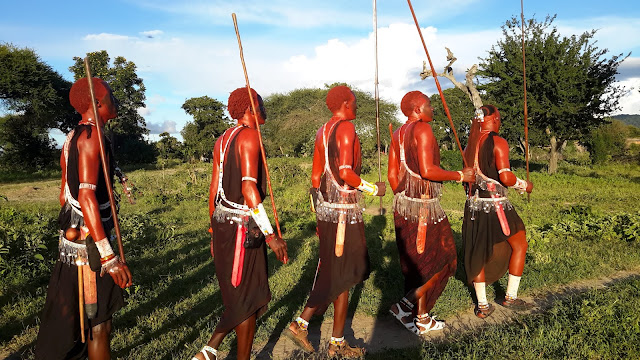 |
| A culture worthy of our love and protection. |
This is all part of the projects I have ran and am currently running. It is all out of love for the people of the Masai tribe and the beautiful land they live in.
With Stephanie's Masai Education Fund Vol. 2 I aim to encourage Masai girls to go to school. I want them to receive the education their tribe needs in order to survive.
Taking Masai children to school is not the end of their tribal culture. It does not have to be. It can be the way to save them. The beautiful Masai.
Check out my campaign to bring reusable sanitary kits to the girl students of our village by clicking
HERE.
Thank you.


